Saturday, November 30, 2013

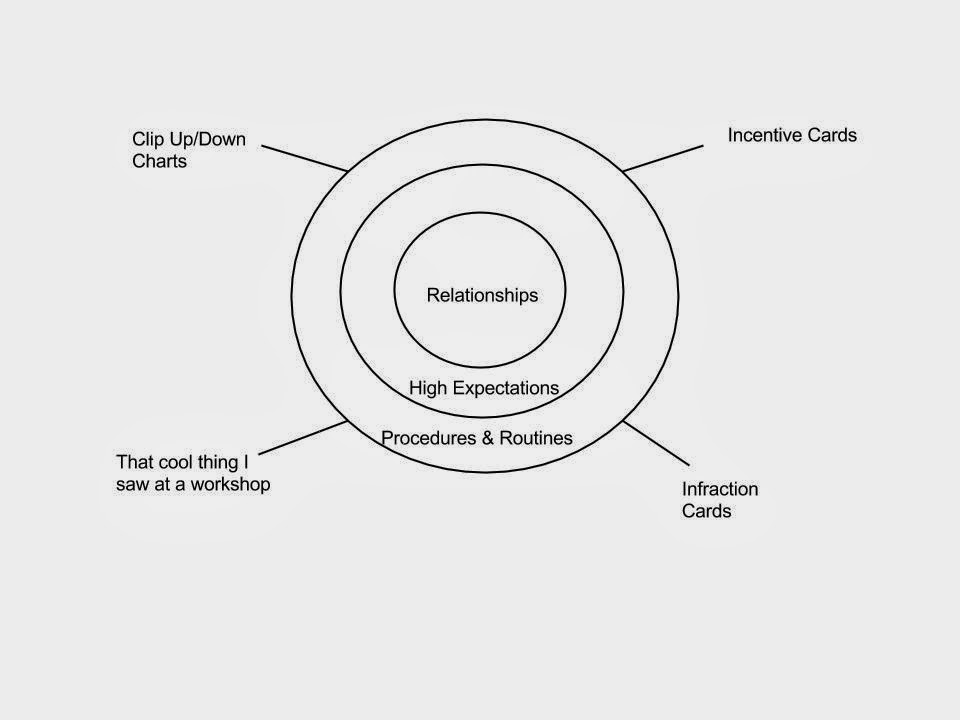
Core of Classroom Management


Classroom Management-at the Core is Relationships

The Core


1. Relationships
Kids don't care what you know until they know you care.  Great classroom managers always maintain the dignity of students. Teachers who know something about their kids are better able to deal with misbehavior. As an adult, who do you want to impress more, the boss who is rude and condescending or the one that regularly makes you feel like a valued member of the team?

2. High Expectations 
Great classroom managers have a strong belief that kids want to learn. These teachers simply won't accept failure to meet classroom expectations and they are persistent. Great classroom managers are in charge of the classroom.  They look for solutions and don't ask others to solve their own classroom management issues (though they do communicate with other teachers to find answers).  Sending a student to the office is rare or simply doesn't happen.  Great classroom managers notice problems and make appropriate adjustments. The classroom environment is regularly checked.  Great classroom managers have high expectations of student behavior and even more importantly, they have high expectations of themselves.

Setting Expectations

3. Procedures and Routines
Students should be able to perform the routines in the classroom on autopilot.  Routines and procedures should be well communicated.  When students come into the room, what is the first thing that they do? Students have a question, how do they get an answer? Students need to sharpen their pencil, when do they do that? How is class ended each day?  Teachers should be able to visualize how they want class to go and then communicate how it looks to students through small and manageable instructions.

Procedures and routines are not meant to be fun.  They are meant to get the routine things done so that you can have fun with what you are supposed to have fun with, learning.

The Cosmetics

What are cosmetics? Cosmetics are on the surface and can enhance already well run classrooms.  Things like up/down charts, reward cards (we have tiger bucks), punch cards, etc. Great classroom managers do these cosmetic things.  So do poor classroom managers.  These things are tools that can help, but without the core of classroom management, will not help.  These "cosmetic" things get a lot of attention by many teachers. Cosmetics look nice and feel good, but only work if the teacher is already a great classroom manager.

Saturday, September 7, 2013

Shift in Thinking: Homework and Grades

In education, it is difficult to make changes due to misperceptions.  Everyone has been in a school and often have an opinion based on their own experience.  Misperception of homework and grading practices can make promising practices difficult to implement.

Homework
Past-Students got homework.  This homework may be a worksheet, crossword puzzles, series of problems, paper, project, etc.  The teacher assigned the homework.  The homework was graded.  Incomplete homework was given a zero.  Late homework was given a reduced grade. Task in-Grade out.  The task may or may not be related to identified essential learnings.

Promising Practices-Students get practice problems or assignments to work on at home and in school. These assignments are to assist the student with identified essential learnings.  If not completed, the student may not perform as well on the in class assessment.  Work completed during class is given immediate feedback and instruction is altered due to students comprehension.

Misperception-School is easy today, students have no consequence for not doing homework.  How will students learn responsibility when deadlines are extended and students can redo an assessment?  What is the motivation to complete the work?

Reality-In class assessment will show the ability of the student.  Students must practice to get better.  The best consequence for incomplete practice is completing the practice if the student is unsuccessful on the in-class assessment.  Homework is not a game of completion but rather essential for mastering concepts.

Shift in thinking-Failure is an important part of the process.  In class assessments allow teachers to understand the ability of the student.  Failure is not forever.  The date of mastery is less important than the mastery itself. Instruction is adjusted based on results of assessments.

Grading
Past-Students are graded on a combination of homework, quizzes, tests, and projects.  Students will be rewarded for completion, at times students are even given a check off grade.  Students will be punished with grades when they do not complete an assignment.  Students complete a task and then are given a grade.  The grade is final, the concept is not re-taught.  When a student struggles, she might be given bonus to improve her grade.  The bonus may or may not be related to the topic of the class.  Grades are given to complete tasks so it makes sense to give a grade for bringing Kleenex to class.

Promising Practices-Students are graded on identified essential learnings.  These grades do not come from homework.  Homework is practice.  Grading while still learning a concept is counterproductive.  Getting a grade on an assignment meant as practice might lead to a lower score in the class due to not understanding the concept from the beginning.  The source of the final grade should be mastery of a standard or essential learning.  Feedback is more powerful than a grade.  Students are given opportunities to improve and show mastery.  Failure is not permanent.

Misperception-Grades motivate students.  Students won't complete assignments without a grade. Grading helps students become responsible.

Reality-Grades motivate high ability students.  Students do complete assignments unless it is busy work that does not lead to better understanding of the essential learnings.  If a student does not master a concept, they must re-do the practice and the assessment.  Students find it easier to do the practice the first time.

Shift in thinking-It's not when it's learned, it's that it's learned.  Failure is a requirement of learning.  Teachers must promote a growth mindset.  Students can't be perfectionists.  Perfection prevents stretching yourself beyond your comfort level.  Grading that punishes students for trying something more difficult is counterproductive.  Growth comes from failure.  Grades should not punish early failure.  Rather, grades should reflect the end result of the failure/learning cycle. Feedback is more important than grades and leads to greater growth.  Feedback gives students direction, learning from both success and failure.

Saturday, August 3, 2013

Middle Level Education at a Crossroad

Middle level education is at a crossroad.  With funding a constant problem, people look for items to cut from the budget.  Most will look for the items that will have the least impact on education.  Middle level education can be an easy place to look for cuts.  We have to recognize what cuts we can't afford and protect those ideas and programs.

So how do we protect middle level education?  How do we make sure that students in the middle don't get overlooked?  How can we frame the debate to make sure that the important parts of middle level education are given the support that is needed?

Middle Level Philosophy worth protecting
  • Collaboration
  • Challenging Curriculum
  • Developmentally Responsive
  • Sense of Community

Collaboration

Grade Level Interdisciplinary teams
Interdisciplinary teams look out for their kids.  They look for ways to make the curriculum come to life and make connections.  This collaboration benefits students in amazing ways.  When teachers know their students and can create a small school feeling, the students are the winners.

Departments

Students benefit when teachers who teach common classes have a chance to collaborate.  Teachers, in the PLC structure (not exclusive to middle level), gain from instructional strategies from teachers they don't even have.  They are guaranteed a curriculum that will be rigorous and that will challenge them to be their best.

Challenging Curriculum

Instructional Quality
What shows up higher on Hattie's Effect Size: Instructional Quality or Instructional Quantity?  Instructional quality, of course.  Granted, instructional quantity is right behind it and both are considered very big influences on achievement. How can we improve our instructional quality without time to learn from each other?

Developmentally Responsive

If you placed 13 teachers who each teach a different level in front of you and asked each teacher the following questions, you would be able to guess within a few years what grade level that teacher teaches.
1) How important is getting to know the kiddos in your class?
2) How important is strong content knowledge?

The teacher who cringes at the word kiddo, but pushes students to higher levels because of their content knowledge, probably teaches high school.  The teacher who gets bored with content discussions but lights up when they see their students walk in the room (and the students light up when they see him/her) is probably in the lower elementary.  In the middle, we are a little of both, content and kid centered.  A middle level education program that fails to recognize students developmental needs can't be successful.  Conversely, a school that treats middle level students as if they were at the elementary level would lose their credibility with the kids and do a disservice to the students academically

Sense of Community
Adult Advocate for every student
All people need a mentor.  Why is it so important that we assure students have someone looking out for them in the middle level?  Kids begin to show signs of who will drop out as early as the 6th grade.  Data will show that students with poor attendance, behavior, and academics in the 6th grade are less likely to graduate.  We can't afford to let kids slip through the cracks.  We must advocate for our students. We must have someone who can watch out for each and every kid.

Safe Environment and Character Education
In a time where bullying has become such a big issue in schools, we can't afford to get rid of character education.  Students who are bullied need an advocate.  Students who bully need to learn a different way. Character will last longer than any other thing that we teach.  Students come to us with a wide array of backgrounds and support.  We must make sure that all kids get the supports they need to be successful in life.

Frame the Debate
It's pretty hard to argue against safe school environment.  It's hard to argue against high quality instruction. Framing the debate so that people understand that it is hard work to collaborate and constantly strive to be better.  We don't team because we think it's easy, but rather to makes a bigger impact on our students. Some say we can't afford to spend so much time collaborating and working on the soft skills. I think it's pretty obvious what we really can't afford.


Friday, July 12, 2013

Homework as Practice


A Few Questions to Consider

Homework should be practice of essential skills and essential learnings.  So......

1.  Do students need practice?

2.  Should practice be graded?

3.  Perfect practice makes perfect.  How do we make sure students perfectly practice?

4.  Do all students need the exact same practice?

5.  Do all students need the exact same amount of practice?

6.  What should feedback look like?


If we don't grade homework......
1.  How do we make sure they do their homework (is it important that a student who has mastered the content do the homework)?

2. How do students and parents know how the student is doing?

3. What are the assessments that are graded and how frequent are these assessments?


If homework is practice, which of the following makes sense?
  • Word Finds
  • Homework every night, no matter what
  • Homework over a topic that hasn't been taught yet
  • Homework over non-essential learnings
  • Extra Credit over non-essential learnings (or extra credit in general)
  • Completion grades
  • "D+" written on the practice assignment by the teacher (or A+ or B-) 
  • One opportunity to practice an essential learning
  • Late work is not accepted
  • Feedback on homework is infrequent or not given


Monday, April 22, 2013

Purpose of homework

What is the purpose of homework?  Is it to assess or practice?  If it is to practice, how do you hold students accountable for the homework without grading the homework?  Whatever the answer is, this should be made clear to students.

Let's focus on homework as practice.

If the purpose of the homework is that it should help students learn, then it is necessary to give students feedback.  Grading the homework makes it into an assessment.  Feedback is much more powerful than a letter or percentage.  Feedback should identify what students can do and what they need to do better.  Homework for the purpose of practice is very powerful.  

Effective practice should encourage students to get help from parents, friends, teachers, youtube, google etc.  After all, practice doesn't make perfect, perfect practice makes perfect.  To grade homework would then not reflect the knowledge of the student.  To not allow help from all possible resources would encourage a student to practice without being sure that they are "perfectly practicing."

If the homework is required, it should be at the correct level for the individual learner.  If a student does not bring the homework completed at the due date, then the student should be required to complete the homework at a designated time (lunch, before school, after school) rather than being give a zero for the behavior of not completing the homework.  Most students would think of losing time as a greater consequence than a zero.  Exceptional students who are very grade conscious would see getting a zero as a big consequence, but are those the students that we are concerned about not turning in their homework?

At other times, homework can be optional.  Why would a student complete the homework? He/she would not complete it unless they see the direct benefit of the homework helping improve their learning and then helping them on the assessment.  The homework will only be beneficial if feedback is provided and it is directly aligned to what is on the assessment.  


Saturday, April 20, 2013

How Many Grades Should be in the Gradebook?


I'm trying to get my head around a question.  How often should grades be put in the gradebook and what does best practices tell us?

I will not answer how many grades should be given but I would love to see your comments on how often grades should be given and how you come to that conclusion.

So here are some of my thoughts:
  • Feedback is more effective than grading.  Feedback actually increases learning by providing valuable information.  Put a grade on it, and the student looks only at the grade, even if feedback is also provided.  The research then shows that no additional learning gains are made for the students once the grade has been placed on the paper/assignment.
  • Feedback is number 1 on Hattie's Effect Size.  However, grading can eliminate the effect of feedback.
  • Feedback should be based on a clearly stated goal.
  • Feedback should answer what they have done well and how they can do better.
  • Students should make mistakes on homework. Feedback should be given to students. 
  • Grades should be based on summative assessments.  In other words, the learning is done, now we can assess with a grade.
  • Grades should not be an accumulation but rather a reflection upon mastery of standards.  The mistakes you made while learning should not be held against you.
"Ditch the obsession with grades, so that pupils can concentrate instead on the comments that the teacher has written on written classwork." Dylan William

Some interesting articles on the topic of effective grading, feedback and/or assessment.

http://www.ascd.org/publications/educational-leadership/feb08/vol65/num05/Effective-Grading-Practices.aspx


Thursday, April 4, 2013

Positive NeSA Test Message-Duck Dynasty Style


Message from my wife to my 3rd grade son before his NeSA test.  Gotta love it.

Keithen,

Hey, look here Jack.  Today is the day you get to show off your mental prowess.  Just like the black panther in the woods, you are going to go in to this quiet and concentrated, then you’re gonna pounce on that NeSA and show it who’s boss.  Hey, keep in mind, you’re so dope, you’re illegal in 50 states.  You can slam this in their face.  You can slam this in their Momma’s face.  Hey, there’s some people that’s got it, and some people who don’t got it, you’ve always had it, you’ve always had it. Hey, do your best and forget the rest, Jack.  That’s Rule #1.  

Good luck, from Mom and Uncle Si!